
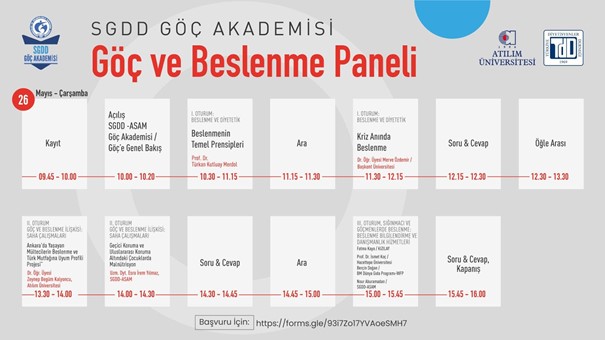
Speakers who participated in the “Migration and Nutrition” panel, organized with the attendance of nearly 100 persons, drew attention to the importance of nutrition for asylum seekers.
Merdol: “Adequate, Balanced and Healthy Nutrition”
Founding member of the Turkish Dietetic Association Prof. Dr. Türkan Kutluay Merdol, in the session on “The Main Principles of Nutrition”, emphasized that the most crucial link in the concept of nutrition is an adequate, balanced and healthy nutrition. Underlining that malnutrition could be the cause of many physical and mental illnesses, Merdol conveyed that cultures have different dietary habits and an accurate and personalized nutrition is very important.
Başkent University Department of Nutrition and Dietetics Assist. Prof. Merve Özdemir explained that migrating asylum seekers, mainly children, generally have poor living conditions during their journey and frequently experience health problems. Pointing out that water, hygiene and sanitation are the most important factors for remaining healthy during migration, Özdemir went on to say, “It is crucial that food are kept clean, raw and cooked food are separated, and the correct cooking methods are used for a safe nutrition during periods of disaster and crisis. Storing food at proper temperatures and using appropriate utensils will reduce the effects of unhealthy conditions.”
Doğan: “Syrian Children’s Nutrition Improved in Turkey”
Turkish Red Crescent’s Health and Psychosocial Support Programme Officer Fatma Kaya, in the session on “Nutrition Among Asylum Seekers and Migrants: Nutrition Information and Counselling Services”, conveyed that they offer service to asylum seekers and migrants in 18 Turkish Red Crescent Community Centers across 17 provinces. Kaya indicated, “We are continuing our activities on a wide scale through social cohesion, protection, strengthening livelihoods, and health and psychosocial support programmes.”
United Nations World Food Programme’s (WFP) Turkey Monitoring and Evaluation Officer Berçin Doğan indicated that in the research conducted with Hacettepe University Institute of Population Studies, they discovered that Syrian children’s nutrition improved after coming to Turkey, but still remain inadequate compared to Turkish children. Emphasizing that financial aid have a significant effect in eradicating the problem of chronic malnutrition in Syrian children, Doğan pointed out that the effect of financial aid is not very significant in terms of acute malnutrition.
Kalyoncu: “Asylum Seekers are faced with Malnutrition Conditions”
Atılım University Assist. Prof. Zeynep Begüm Kalyoncu, in the session on “The Relationship between Migration and Nutrition: Field Activities”, explained that during their field activities, they observed that most asylum seekers living in Turkey have problems in terms of shelter, health, employment and family planning. Kalyoncu stated that they reached the conclusion that most of the asylum seekers are forced to work in unregistered jobs for long hours and for low wages.
ASAM Nutrition Specialist Esra İrem Yılmaz shared the conclusions of the report on Malnutrition in Children under Temporary Protection and International Protection, prepared by ASAM Academy on Migration. Yılmaz expressed that 1 out of every 6 children are stunted, while 1 out of every 13 children are underweight.

